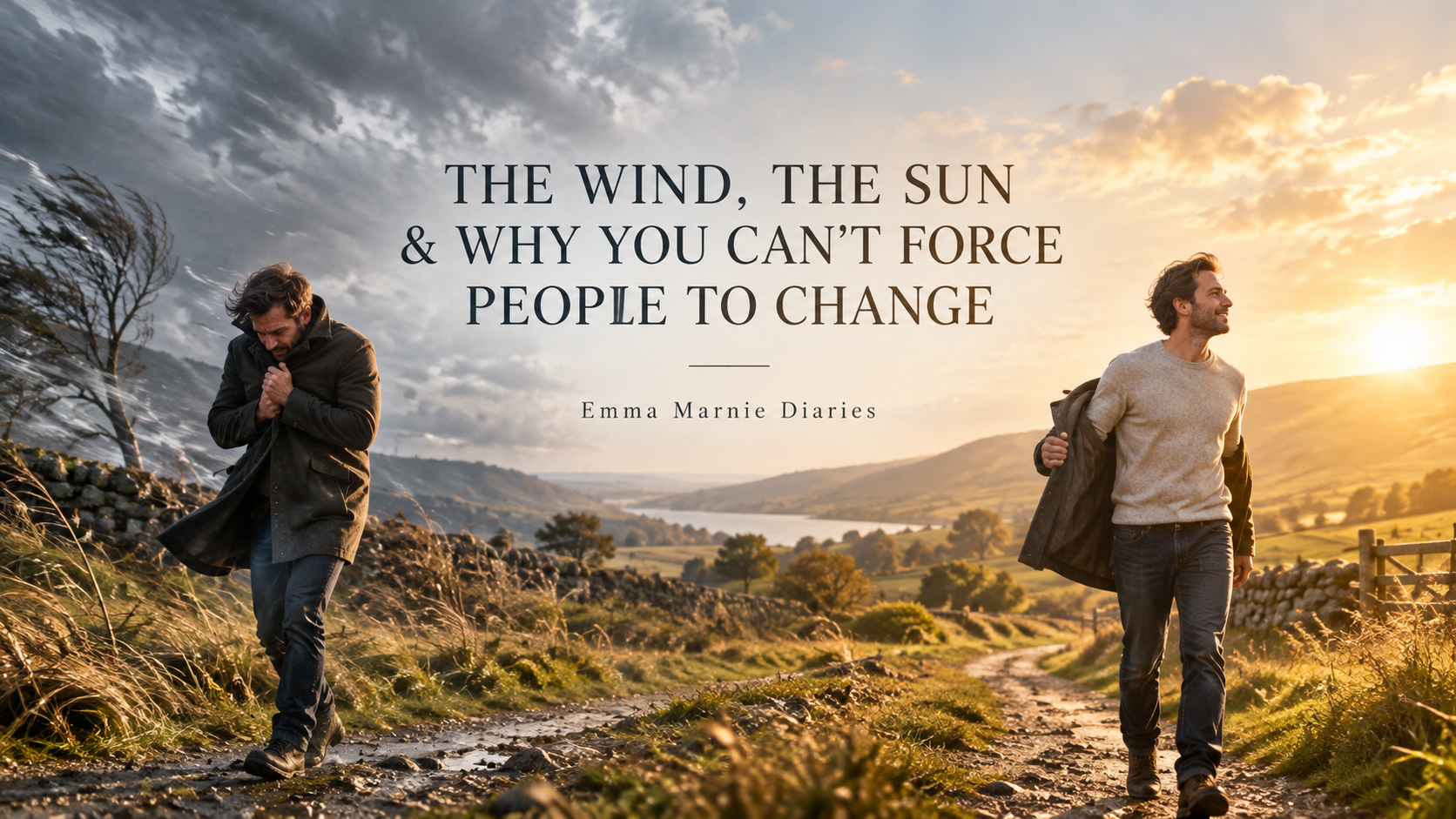
Years ago, I used to tell people the story of The North Wind and the Sun.
Not because I had suddenly become some sort of travelling Greek philosopher in sandals, but because it explained something I had learned the hard way:
You cannot force people to change.
The story is simple.
The Wind and the Sun are arguing about which of them is stronger.
They see a man walking along wearing a coat and decide to have a competition.
Whoever can get the man to take his coat off wins.
The Wind goes first.
He blows.
The man grabs his coat.
So the Wind blows harder.
The man pulls the coat tighter around himself.
The Wind gets stronger, angrier and more determined.
And the man becomes equally determined to keep hold of the bloody coat.
Eventually the Wind gives up.
Then the Sun has a go.
The Sun doesn’t pull.
It doesn’t threaten.
It doesn’t shout.
It just shines.
Slowly, the man gets warmer.
He loosens the coat.
Then eventually, completely of his own accord, he takes it off.
And there it is.
A tiny old story containing one of the biggest lessons I have ever learned about human behaviour.
People Dig Their Heels In
Have you ever told somebody exactly what they need to do?
And they immediately do the opposite?
Of course you have.
Humans are magnificent like that.
Tell somebody:
“You need to leave that relationship.”
They defend the relationship.
“You need to stop drinking.”
Suddenly they have seventeen perfectly reasonable explanations for why their drinking is absolutely fine.
“You need therapy.”
Apparently everyone else is now the problem.
“You need to stop doing that.”
Well, now they are going to do it extra hard just to prove a point.
We like to believe we are rational creatures.
We are not.
We are emotional little goblins with opinions.
When people feel pushed, controlled, criticised or cornered, something inside them often pushes back.
The harder you pull at the coat, the tighter they hold it.
You Can’t Rescue Someone Before They’re Ready
This is one of the hardest lessons when you care about somebody.
You can see the disaster coming.
Sometimes you can see it from bloody space.
You know what needs to change.
You know what would help.
You know exactly where the path they are on is going.
And naturally, you want to grab them by the shoulders and shout:
FOR THE LOVE OF GOD, CAN YOU NOT SEE THIS?
Unfortunately, that rarely works.
People have to reach their own conclusions.
You can support them.
You can listen.
You can share your experience.
You can point things out.
You can ask questions.
But ultimately, they have to be the one who decides to take the coat off.
Plant Seeds Instead
This is something I believe very strongly.
Plant seeds.
You don’t have to win the argument today.
You don’t have to make somebody understand immediately.
You don’t even need them to agree with you.
Sometimes you say something small.
Then leave it alone.
Weeks later, months later, sometimes years later, something happens in that person’s life and suddenly your words come floating back.
“Oh.”
“Ohhhh.”
“That’s what she meant.”
That is the seed growing.
And because the thought now feels like their own realisation, they are much more likely to act on it.
This same idea sits at the heart of my human translation of the Twelve Steps: listen, notice, help where you can, and plant little seeds rather than dragging anyone towards change.
This Is Why Listening Matters
Sometimes people don’t need another lecture.
They need somewhere safe enough to hear themselves think.
That might mean asking:
“What do you think is happening?”
“How is this affecting you?”
“Do you actually want things to stay like this?”
“What would happen if nothing changed?”
Those questions can do far more than:
“You’re doing everything wrong and here is my twelve-point plan for fixing your life.”
Nobody likes being handed a clipboard containing instructions for becoming a better human.
Change Usually Happens Quietly
Real change is often much less dramatic than people imagine.
There isn’t always a giant revelation.
Sometimes it is just a collection of tiny moments.
A conversation.
A sentence.
Something somebody said months ago.
A consequence that finally hurt enough.
A feeling of being tired of repeating the same bloody cycle.
Then one day the person becomes ready.
And suddenly something that was impossible six months ago feels obvious.
That is why patience matters.
You can’t drag somebody to readiness.
It begins with honesty too—which is why you can’t fix what you won’t admit is broken.
Be the Sun
This doesn’t mean becoming endlessly nice or tolerating bad behaviour.
Boundaries still matter.
Sometimes you absolutely need to step away.
Sometimes the kindest thing you can do is stop rescuing somebody from the consequences of their own choices.
But if your goal is to help somebody see something differently, force is usually a terrible tool.
Be curious.
Be patient.
Say what needs saying.
Plant the seed.
Then leave it alone.
You don’t have to keep digging the bloody thing up every five minutes to see whether it has grown.
Just shine a little light on it.
People change when they are ready to change.
Not when we demand it.
Not when we shout louder.
Not when we win the argument.
And definitely not because we tried to rip the coat off them.
Sometimes the strongest thing you can do is simply plant the seed…
and wait for the Sun.
Think someone could use this?
If this made you think of someone, share it with them. Sometimes the right words find people at exactly the right time.
Stay for another one